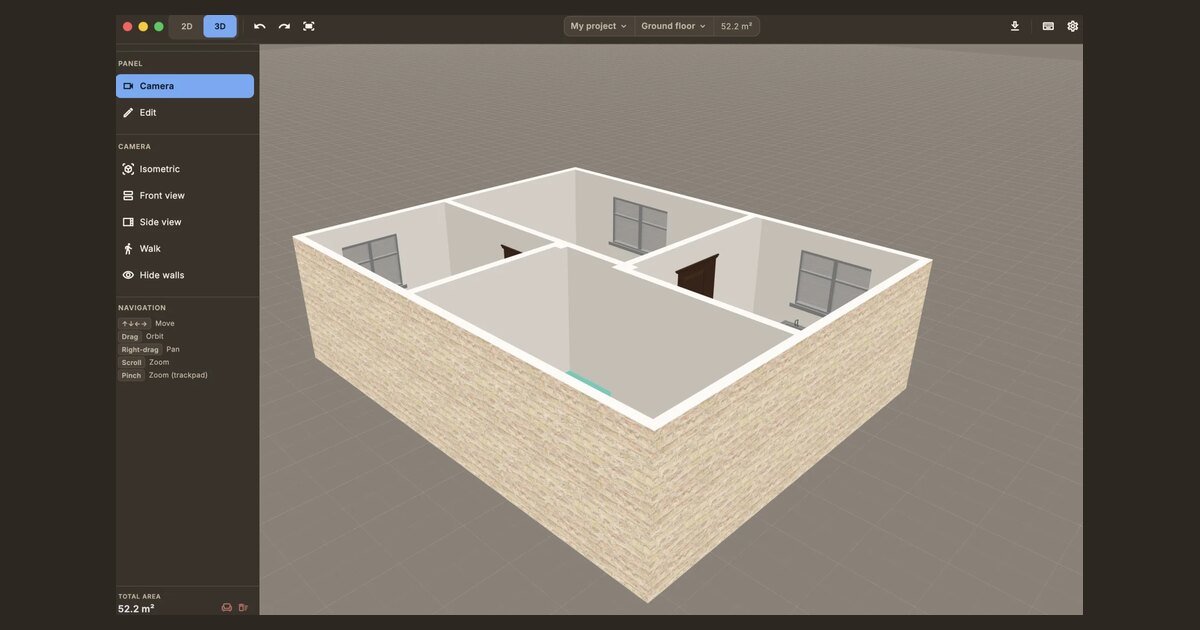
A Mac app and its web version: what the second one really costs
Sharing code between a desktop app and its browser version does not halve the work. Here is what the second platform ac…
 Mickael Romaniello
30 minutes, no slides, nothing to prepare.
Mickael Romaniello
30 minutes, no slides, nothing to prepare.
Good UX is not only about making an app "beautiful". It is also about reducing the user's anxiety.

When someone opens Airbnb, they often feel something very specific : a sense of immediate trust. And honestly, it's absolutely not by accident.
Because Airbnb works heavily on a topic that's often underestimated in mobile : reducing user doubt.
Before booking anything, the app already answers a lot of implicit questions :
And this is exactly where Airbnb is strong. The app uses huge photos, ratings visible everywhere, detailed human reviews, user profiles, neighborhood info, deadlines, "Superhost" badges, very visible cancellation policies.
None of this is purely informational. It's mainly reassurance. And that nuance is extremely important.
Because good UX isn't only about making an app "beautiful". It is also about reducing anxiety — though the two are less separate than they sound.
Visual judgement happens faster than deliberate thought. A study at Carleton University concluded that "visual appeal can be assessed within 50 ms, suggesting that web designers have about 50 ms to make a good first impression" (Lindgaard et al., Behaviour & Information Technology, 2006). A later replication by Google researchers pushed it further, finding that visual complexity and conventionality "affect aesthetic perception even within 17ms", and that "websites with low VC and high PT were perceived as highly appealing" — low visual complexity, high prototypicality (Tuch et al., IJHCS, 2012).
The key difference worth stating plainly is that those studies measured appeal, not trust or a decision to stay — the common claim that "users decide in 50 milliseconds" overstates them. The bridge to trust comes from separate work : presenting identical content with a higher aesthetic treatment led it to be "judged as having higher credibility", an effect the authors observed "within the first few seconds" (Robins & Holmes, Information Processing & Management, 2008). In short : a calm, conventional layout is not decoration. It is the first credibility signal the product sends, and it arrives before a single word is read.
When a user doubts, they hesitate, they compare, they delay the decision, sometimes they leave the app entirely.
Airbnb understood very early that booking a stay between strangers can be stressful. So the app constantly works on trust. This approach is very close to what Apple's Human Interface Guidelines call "clarity" — the first of the three design principles.
Even elements that look like "marketing" often have a psychological function :
Everything is designed to help the user make a decision more calmly.
Today, many products still think "features". The best apps think "emotions". And that difference changes a lot.
Because in the end, the user doesn't memorize your feature list. They memorize how they felt during their journey.
Want to reduce doubt in your app's purchase flow ? Book a 30-minute call to identify the moments where your user is still hesitating.
12 years of experience, iOS + Android, one dedicated contact. Free 30-minute call to scope your need — no commitment, no jargon.
Book a call →
When someone opens Airbnb, they often feel something very specific : a sense of immediate trust. And honestly, it's absolutely not by accident.
Because Airbnb works heavily on a topic that's often underestimated in mobile : reducing user doubt.
Before booking anything, the app already answers a lot of implicit questions :
And this is exactly where Airbnb is strong. The app uses huge photos, ratings visible everywhere, detailed human reviews, user profiles, neighborhood info, deadlines, "Superhost" badges, very visible cancellation policies.
None of this is purely informational. It's mainly reassurance. And that nuance is extremely important.
Because good UX isn't only about making an app "beautiful". It is also about reducing anxiety — though the two are less separate than they sound.
Visual judgement happens faster than deliberate thought. A study at Carleton University concluded that "visual appeal can be assessed within 50 ms, suggesting that web designers have about 50 ms to make a good first impression" (Lindgaard et al., Behaviour & Information Technology, 2006). A later replication by Google researchers pushed it further, finding that visual complexity and conventionality "affect aesthetic perception even within 17ms", and that "websites with low VC and high PT were perceived as highly appealing" — low visual complexity, high prototypicality (Tuch et al., IJHCS, 2012).
The key difference worth stating plainly is that those studies measured appeal, not trust or a decision to stay — the common claim that "users decide in 50 milliseconds" overstates them. The bridge to trust comes from separate work : presenting identical content with a higher aesthetic treatment led it to be "judged as having higher credibility", an effect the authors observed "within the first few seconds" (Robins & Holmes, Information Processing & Management, 2008). In short : a calm, conventional layout is not decoration. It is the first credibility signal the product sends, and it arrives before a single word is read.
When a user doubts, they hesitate, they compare, they delay the decision, sometimes they leave the app entirely.
Airbnb understood very early that booking a stay between strangers can be stressful. So the app constantly works on trust. This approach is very close to what Apple's Human Interface Guidelines call "clarity" — the first of the three design principles.
Even elements that look like "marketing" often have a psychological function :
Everything is designed to help the user make a decision more calmly.
Today, many products still think "features". The best apps think "emotions". And that difference changes a lot.
Because in the end, the user doesn't memorize your feature list. They memorize how they felt during their journey.
Want to reduce doubt in your app's purchase flow ? Book a 30-minute call to identify the moments where your user is still hesitating.
12 years of experience, iOS + Android, one dedicated contact. Free 30-minute call to scope your need — no commitment, no jargon.
Book a call →We write about mobile app development, user experience design, App Store optimization, project management, and industry trends. Our articles are based on real experience from client projects.
We aim to publish regularly with a focus on quality over quantity. Each article is written from hands-on experience, not generic advice.
Absolutely! Feel free to reach out via our contact page or book a consultation. We love hearing what questions our readers and clients have.
Most of my projects run remotely, and in practice that changes very little. We talk over video whenever you need to, not only at major milestones, and you can reach me with questions at any point during the project — I always answer.
You can also write to me directly on WhatsApp: same number I use every day, a French professional line that works internationally.