Your craft deserves better than an Excel sent late at night
Many trades still rely on WhatsApp PDFs, Google Forms and voice memos. You don't need "the next Uber" — a simple app is…
 Mickael Romaniello
30 minutes, no slides, nothing to prepare.
Mickael Romaniello
30 minutes, no slides, nothing to prepare.
The events industry needs mobile tools that create a direct link with attendees. Here are 3 concrete app ideas to transform your trade shows.
An event app has a constraint almost no other product has: it must work perfectly for 2 or 3 days, in a building designed to block radio signals, for thousands of people who all open it at the same moment. Everything else follows from that. Here are 3 ideas that survive those conditions — and the reason each one is harder than it looks.
Trade-show halls are concrete, steel and glass, packed with people whose phones are all fighting for the same cells. Wi-Fi is oversubscribed by mid-morning. Any feature that assumes a live request will fail exactly when the room is fullest — which is the moment the app is being judged.
Android's architecture guidance is unambiguous about the fix: "there must be at least one data source that does not need network access to perform its most critical tasks", and a local database is "the recommended source of truth for providing offline-first support". The app should "present users with local data immediately instead of waiting for the first network call to complete or fail" (Android Developers, 2026).
In short: build offline-first, or the 3 ideas below will demo beautifully in your office and fall over on the floor.
The single most-used screen at any event is "what is on, where, and when". It is also the one that changes: a speaker is late, a room is swapped, a session is cancelled 20 minutes before it starts. A printed programme cannot do that, which is the whole reason the app exists.
What makes it hard is that the update has to reach a device that may be offline. The pattern that works is a cached programme rendered from local storage, a small delta synced whenever connectivity returns, and a visible timestamp so an attendee knows how fresh their copy is. The key difference from a normal app is that "stale but honest" beats "blank and correct".
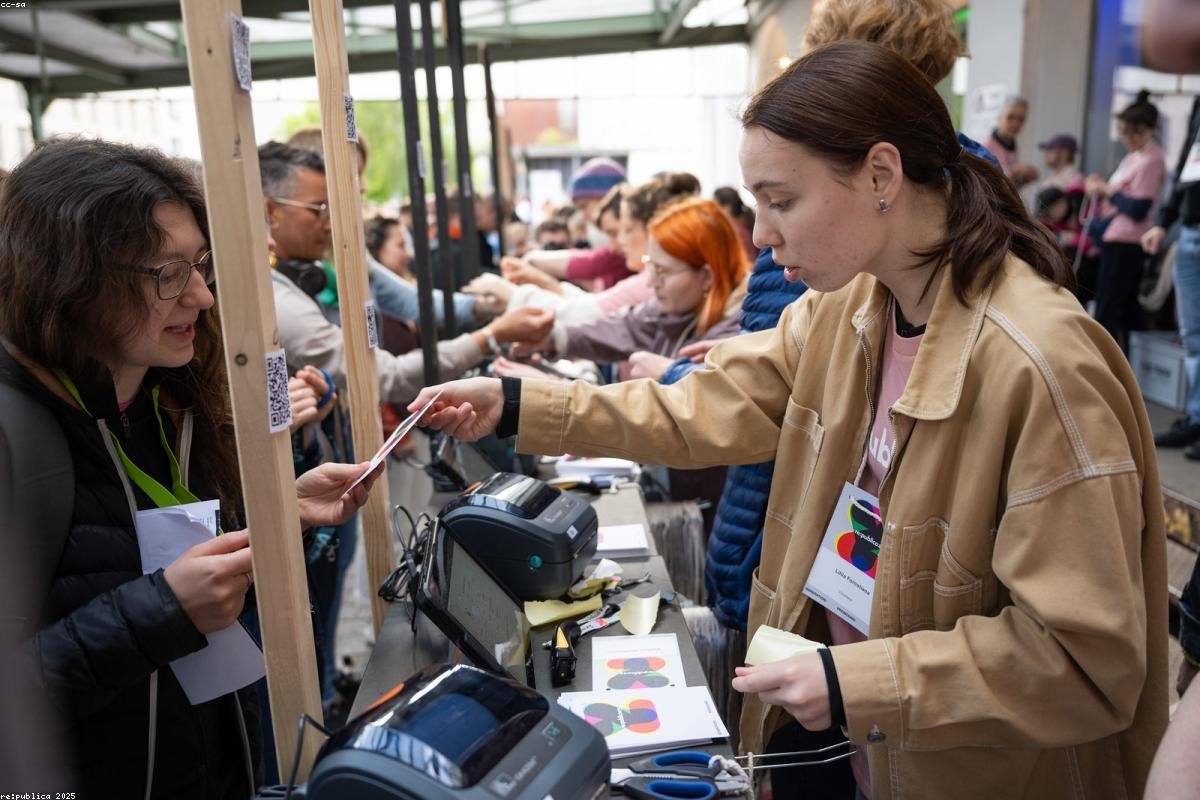
For an exhibitor, the event has one metric: qualified conversations. Badge scanning turns a business card pile into a structured list, and it is the feature most likely to make the app a revenue line rather than a cost line.
The engineering reality is that scanning happens in the worst possible conditions — bad light, a lanyard flipped backwards, a queue forming. So the scan must be local and instantaneous, the record must be written to the device first and synced later, and a failed scan must offer manual entry rather than a spinner. Add a note field: the reason a lead is qualified is almost never on the badge.
GPS is unreliable indoors, so an event map cannot rely on a blue dot. What works is duller and much cheaper: a zoomable floor plan bundled with the app, stands searchable by name and number, and a route described in the way people actually give directions — "Hall 2, aisle C, opposite the coffee point".
Bottom line: attendees do not need centimetre precision. They need to find stand C14 without signal, and to have starred it that morning while they still had Wi-Fi at the hotel.
An event app is used intensely for 3 days and then sits on the phone. That has two consequences worth planning for. The first is that the store listing and the app must not go stale between editions — Google Play requires apps to keep up with target API levels to stay discoverable, and apps below the required level "stop being discoverable to all Google Play users whose devices run Android OS versions newer than your app's target API level" (Google Play Console Help, 2026). An app parked for a year quietly stops appearing on newer devices.
The second is that the most valuable moment is the week after. The scanned leads, the sessions people actually attended, the stands they starred — that is the data next year's edition is built on, and it is the reason to keep one product rather than commission a new app each year.
Planning an event app and want the offline constraints designed in from the start ? Book a 30-minute call.
Building apps since 2013, iOS + Android, one dedicated contact. Free 30-minute call to scope your need — no commitment, no jargon.
Book a call →
An event app has a constraint almost no other product has: it must work perfectly for 2 or 3 days, in a building designed to block radio signals, for thousands of people who all open it at the same moment. Everything else follows from that. Here are 3 ideas that survive those conditions — and the reason each one is harder than it looks.
Trade-show halls are concrete, steel and glass, packed with people whose phones are all fighting for the same cells. Wi-Fi is oversubscribed by mid-morning. Any feature that assumes a live request will fail exactly when the room is fullest — which is the moment the app is being judged.
Android's architecture guidance is unambiguous about the fix: "there must be at least one data source that does not need network access to perform its most critical tasks", and a local database is "the recommended source of truth for providing offline-first support". The app should "present users with local data immediately instead of waiting for the first network call to complete or fail" (Android Developers, 2026).
In short: build offline-first, or the 3 ideas below will demo beautifully in your office and fall over on the floor.
The single most-used screen at any event is "what is on, where, and when". It is also the one that changes: a speaker is late, a room is swapped, a session is cancelled 20 minutes before it starts. A printed programme cannot do that, which is the whole reason the app exists.
What makes it hard is that the update has to reach a device that may be offline. The pattern that works is a cached programme rendered from local storage, a small delta synced whenever connectivity returns, and a visible timestamp so an attendee knows how fresh their copy is. The key difference from a normal app is that "stale but honest" beats "blank and correct".
For an exhibitor, the event has one metric: qualified conversations. Badge scanning turns a business card pile into a structured list, and it is the feature most likely to make the app a revenue line rather than a cost line.
The engineering reality is that scanning happens in the worst possible conditions — bad light, a lanyard flipped backwards, a queue forming. So the scan must be local and instantaneous, the record must be written to the device first and synced later, and a failed scan must offer manual entry rather than a spinner. Add a note field: the reason a lead is qualified is almost never on the badge.
GPS is unreliable indoors, so an event map cannot rely on a blue dot. What works is duller and much cheaper: a zoomable floor plan bundled with the app, stands searchable by name and number, and a route described in the way people actually give directions — "Hall 2, aisle C, opposite the coffee point".
Bottom line: attendees do not need centimetre precision. They need to find stand C14 without signal, and to have starred it that morning while they still had Wi-Fi at the hotel.
An event app is used intensely for 3 days and then sits on the phone. That has two consequences worth planning for. The first is that the store listing and the app must not go stale between editions — Google Play requires apps to keep up with target API levels to stay discoverable, and apps below the required level "stop being discoverable to all Google Play users whose devices run Android OS versions newer than your app's target API level" (Google Play Console Help, 2026). An app parked for a year quietly stops appearing on newer devices.
The second is that the most valuable moment is the week after. The scanned leads, the sessions people actually attended, the stands they starred — that is the data next year's edition is built on, and it is the reason to keep one product rather than commission a new app each year.
Planning an event app and want the offline constraints designed in from the start ? Book a 30-minute call.
Building apps since 2013, iOS + Android, one dedicated contact. Free 30-minute call to scope your need — no commitment, no jargon.
Book a call →We write about mobile app development, user experience design, App Store optimization, project management, and industry trends. Our articles are based on real experience from client projects.
We aim to publish regularly with a focus on quality over quantity. Each article is written from hands-on experience, not generic advice.
Absolutely! Feel free to reach out via our contact page or book a consultation. We love hearing what questions our readers and clients have.
Most of my projects run remotely, and in practice that changes very little. We talk over video whenever you need to, not only at major milestones, and you can reach me with questions at any point during the project — I always answer.
You can also write to me directly on WhatsApp: same number I use every day, a French professional line that works internationally.